

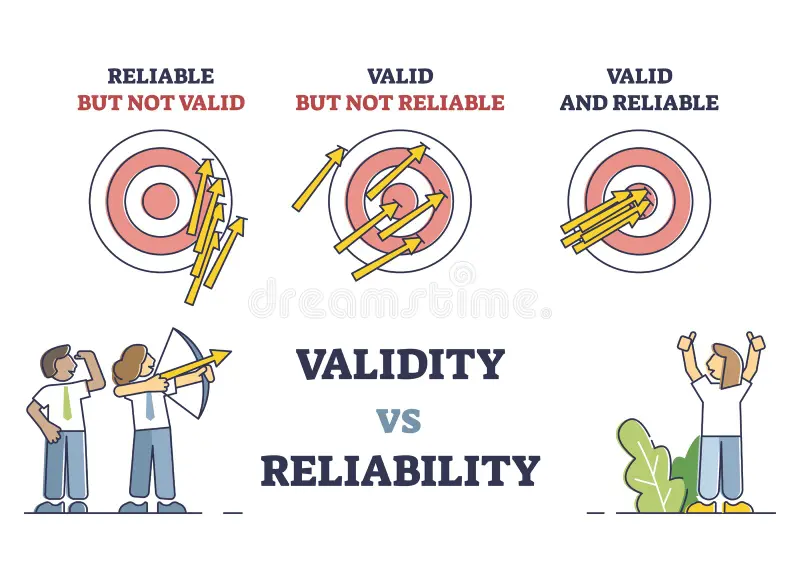
Validity: Validity refers to how accurately a study measures what it is intended to measure. In other words, it asks whether researchers are actually testing the concept or outcome they claim to be investigating. A study can produce consistent results, but if it is measuring the wrong thing, those results are not valid. Researchers consider several types of validity, including internal validity (whether the study design allows researchers to confidently attribute results to the intervention being tested) and external validity (whether the findings can be generalised to other populations or settings). High validity helps ensure that research findings are meaningful, accurate, and useful in the real world.
Reliability: Reliability refers to the consistency and stability of a measurement or study's results over time. A reliable method should produce similar results when repeated under the same conditions. For example, if a scale gives a different weight reading every time a person steps on it, it would be considered unreliable. In research, reliability can refer to the consistency of survey responses, laboratory measurements, observations, or assessment tools. High reliability increases confidence that findings are dependable and not simply the result of chance or measurement errors.
A useful way to remember the difference: Imagine throwing darts at a dartboard. If all your darts land close together but far from the bullseye, your throws are reliable but not valid. If your darts are scattered all over the board, they are neither reliable nor valid. If they consistently hit the bullseye, they are both reliable and valid. Reliability is about consistency, while validity is about accuracy.
Add comment
Comments